Programs

Foundations in both languages.

People starting out, or coming from another field, who want the foundations in both working languages before choosing a specialism.

Opens later12 weeks · Python foundations to R foundations to First build

No job is guaranteed. We do not promise placement, an interview, or an offer.

Rulebook zone 17″ plate Break, inches glove side arm side
  • Four-seam95.2 mph · +17″ vert · +8″ horz
  • Slider86.4 mph · +1″ vert · -6″ horz
  • Changeup87.9 mph · +6″ vert · +13″ horz
  • Curveball79.6 mph · -10″ vert · -11″ horz
Is this you

Three things people say before they start.

If none of these are familiar, this is probably not the right program, and the call will tell you that faster than the page will.

  • Every posting wants experience, and experience is the thing you are trying to get.
  • You have finished courses and have nothing you can show for them.
  • You can write the code and freeze when somebody asks what it means.
Chris Fonnesbeck teaching a masterclassA Bayesian modeling room, mid-build.

This is a real session, not a promotional cut. Modeling and App Development runs live alongside the program.

The plan

12 weeks, week by week.

Each phase names the skills you work on, what exists at the end of it, and what you can do by then.

Languages and tools across the program
PythonR
Weeks 1 to 4

Python foundations

Start where most job postings start, on data you actually care about.

In these weeks
  • Python and pandas from the beginning
  • Reading, cleaning, and joining real sports data
  • Charts that answer a question rather than decorate one
  • End-to-end git workflow: branches, review, and QA gates before anything lands
What exists at the end
A first notebookA cleaned dataset
By now you can

Load a season of data, clean it, and answer a question about it that nobody handed you the answer to.

Weeks 5 to 8

R foundations

The second language, because sports analytics runs on both and picking a side this early is a mistake.

In these weeks
  • R and the tidyverse alongside what you already know
  • Publication-quality charts
  • Reproducible reports someone else can rerun
  • Your first end-to-end small project
What exists at the end
A reproducible reportA finished small project
By now you can

Work in whichever of the two languages the task actually suits, and say why you chose it.

Weeks 9 to 12

First build

Turning coursework into the one thing a reader will actually open.

In these weeks
  • A portfolio project carried end to end
  • A writeup someone outside the work can follow
  • Simulated technical interviews, recorded and reviewed
What exists at the end
A shareable portfolio pageA defended project
By now you can

Show someone your work and explain what you would do differently if you started it again.

Not sure which phase you would start from? That is the first thing the call works out.

Ask about this program
What you will have built

This is the portfolio, not a description of one.

Every one of these is drawn from a model you write yourself, on data you choose. Scroll and they build themselves, which is roughly what it feels like the first time your own one works.

Pick your sport. The methods are the same underneath: a model, honest evaluation, and a chart that makes one point. The sport is what makes you care enough to finish it.

Baseball

Pitch tracking, and why the break chart is the tell

Located pitches with break tails, plus horizontal against induced vertical break by pitch type.

Rulebook zone 17″ plate Break, inches glove side arm side
  • Four-seam95.2 mph · +17″ vert · +8″ horz
  • Slider86.4 mph · +1″ vert · -6″ horz
  • Changeup87.9 mph · +6″ vert · +13″ horz
  • Curveball79.6 mph · -10″ vert · -11″ horz
You build this in weeks 1 to 4

Velocities and break values are illustrative, in the ranges these pitch types actually live in. No real pitcher, team or game.

Basketball

The shot chart that killed the mid-range

Expected points per shot over a half court, with a five-touch possession drawn on top.

  • 0.7expected points per shot
  • 0.95the mid-range trough
  • 1.3rim and corners
  • Possessionfive touches, one shot
You build this in weeks 5 to 8

Shot volumes and percentages are illustrative. The shape is the real argument: a corner three beats a long two on value, not on vibes.

Soccer

Expected goals, and who actually touched the ball

Open-play xG as a logistic in goal angle and log distance, under a passing network sized by touches.

GKRBCBCBLBDMRMCMLWSTAM Open-play xG surface 7.32 m goal
  • xG surfaceangle and distance to goal
  • Node sizetouches in the match
  • Edge weightpasses completed between pair
You build this in weeks 5 to 8

Positions, touch counts and pass volumes are illustrative. Pitch and penalty-area dimensions are the real ones.

Football

A route tree, and the number that moves on every play

Routes drawn at real depths off the line, beside a win probability line across one drive.

+5+10+15+20+25 line of scrimmage FlatSlantOutDigCornerGo Win prob. 50% one drive, eight plays
  • Route depthsflat 2.5, out 12, dig 15, corner 18 yards
  • Biggest swing+0.30 on the turnover
You build this in weeks 9 to 12

The drive and its probabilities are invented. Route depths are the ones these routes are actually run at.

Tennis and golf

Where the serve actually goes

Two-sigma dispersion ellipses from a bivariate normal, the same object as a golfer's shot cone.

net service line, 21 ft Wide 31%Body 22%T 47%
  • Two-sigma ellipsebivariate normal spread of where serves land
  • Same objecta golfer's shot cone, rotated
You build this in weeks 9 to 12

Landing-point means, spreads and shares are illustrative. Court and service-box dimensions are the real ones.

Track

Why the second 200 hurts

A sprint model integrated in the browser: force, a falling top speed, and drag, with 100 meter splits read off the curve.

time (s) velocity (m/s) 100 m11.22s200 m21.70s300 m33.25s400 m46.36s first 200 in 21.70s, second 200 in 24.65s
  • 46.36smodeled 400 m
  • +2.95sthe second-200 fade
You build this in weeks 1 to 4

An illustrative runner, not a real performance. The split pattern is the one a well-run 400 produces.

Inside the program

The 4 sessions and courses it is built from.

Each one is on sale on its own, as a recording you buy once, on its own page. The program is the order, the weekly work around them and the capstone at the end.

Sessions 2

Async masterclass · 75 min What Fills the Seats Greg MatthewsPhD · Director, Center for Data Science and Consulting @ Loyola University Chicago Available now After this you can fit ridge, lasso and elastic net on the same data, tune them honestly, and pick the one that generalizes.
Async masterclass · 75 min FILL THE GAPS The Injury Report Problem Greg MatthewsPhD · Director, Center for Data Science and Consulting @ Loyola University Chicago Available now After this you can run a complete multiple-imputation workflow on a sports dataset full of holes and pool the results correctly.

Courses 2

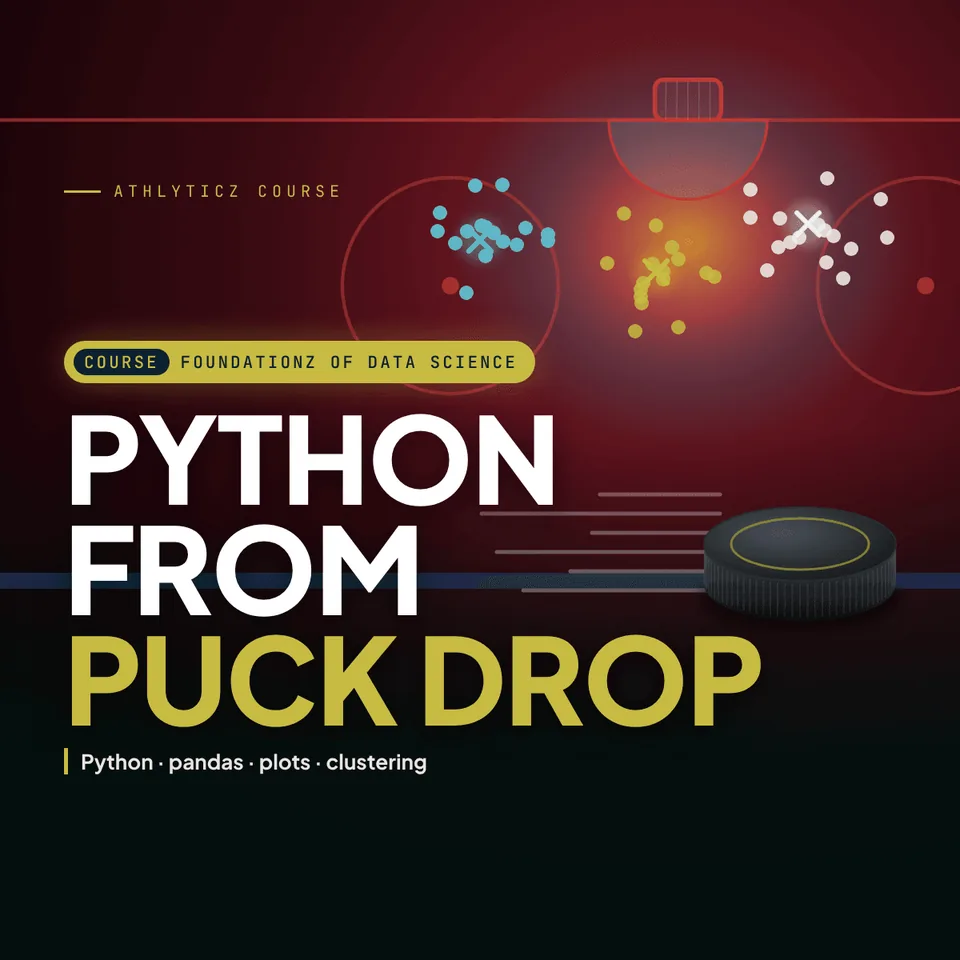
Course · 66 lessons PYTHON FROM PUCK DROP FoundationZ of Data Science Evan Callaghan Available now After this you can load a season of data in Python, clean it, and answer a question nobody handed you the answer to.
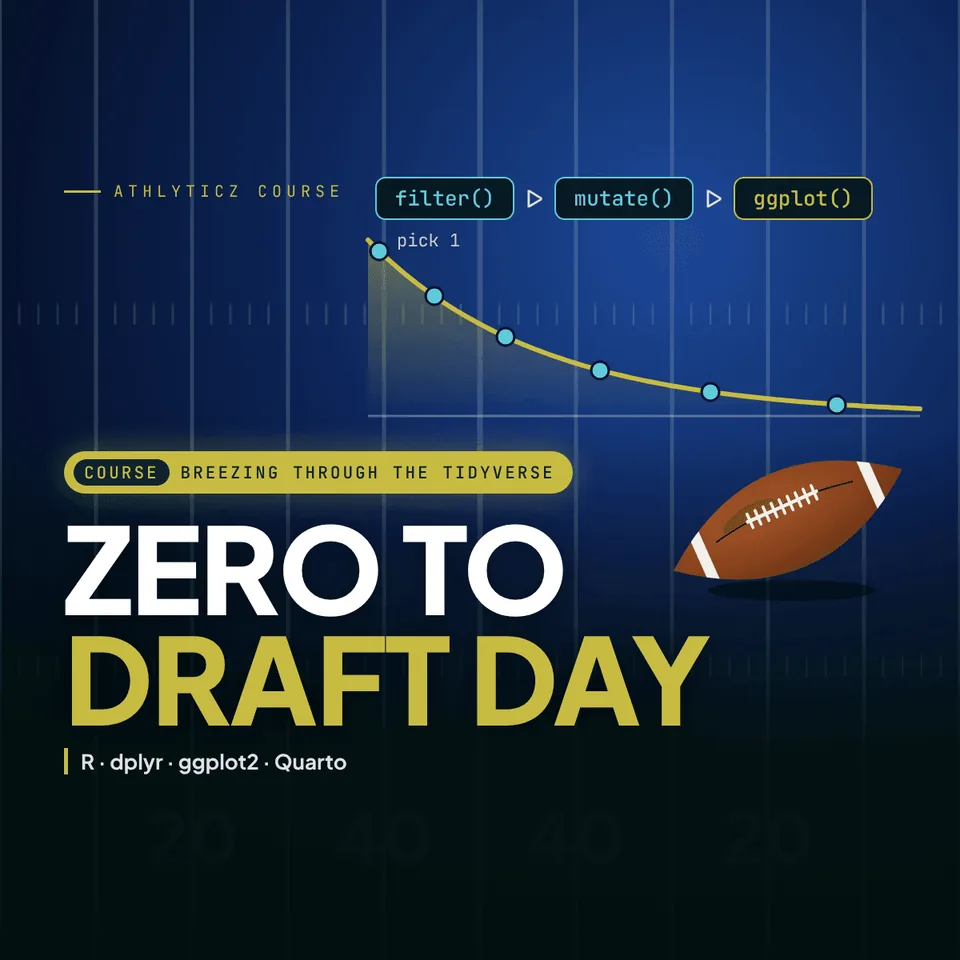
Course · 56 lessons ZERO TO DRAFT DAY BreeZing Through the Tidyverse Paul SabinPhD · Co-Founder @ Sage Sports Group Available now After this you can turn raw NFL, NBA or MLB data into an R report that reruns and gives the same answer.
The Coaching Room

Practice with somebody on the other side of the table.

AI coaching is built into the practice sessions. The coach takes the stakeholder's part, and you work the problem in whatever medium the question actually calls for.

AI as copilot, not autopilot. You learn to direct the machine and defend the output. The scarce part is not producing an answer; it is knowing whether the answer is right and being able to say why in a room that will push back.

Simulated practice

A clock, a real task, and a room that pushes back.

How it actually runs, and the kind of question it runs on.

Practice is timed. You get a real task and a clock, not a quiz. The session is recorded, and the review afterwards is about the reasoning you showed rather than whether you reached the expected answer.

Scenarios are written the way the question actually arrives
  • Someone hands you a spreadsheet and asks whether the team is actually getting better. What do you check first?
  • Explain your chart to someone who has never seen this data before, in under a minute.
  • You found something surprising. How do you check it is real before you tell anyone?
Questions

The ones people ask first.

Will I get a job at the end?

No job is guaranteed. We do not promise placement, an interview, or an offer. What the program promises is the work: a capstone you can defend, a portfolio with real builds in it, and interview practice that is recorded and reviewed.

What does it cost?

There is no public price and no checkout on this page. Cost, dates and where you would start are settled on a short call, and the honest answer is sometimes that a single session or course is the better start.

Which weeks would I start from?

That is the first thing the call works out. The plan on this page is the whole route; a person who already has the foundations starts further along it.

Not into sports?

Then take the method and leave the sport. Cleaning real data, answering one question honestly and explaining it to someone who does not code is the foundation. It is the first thing you do in any of these fields:

  • Every sector The first data job in any industry starts with these habits
  • Public sector Reporting and analysis on data nobody prepared for you
  • Non-profit Small teams where one person is the whole analytics function
  • Any specialism The route into modeling, engineering, LLM, or production work
What runs alongside the taught weeks?

Simulated technical interviews, recorded and reviewed. Front-office presentation practice, where a recommendation meets a room that pushes back. AI orchestration: planning work for delegation, delegated builds, and the checks that catch what a model got wrong.

Modeling and App Development is the live track running alongside the program, so the weekly sessions and the plan pull in the same direction.
Next step

Ask.

There is no public price and no checkout on this page. A short call settles cost, dates and where you would start, and if a single session is the better start we will say so.

No job is guaranteed. We do not promise placement, an interview, or an offer.

Ask about this program
Keep up

One email when something new arrives.

First name and email. One message when a session recording, a skill, a cheat sheet or a posting worth your time arrives here, and no other mail. Replies reach a person.