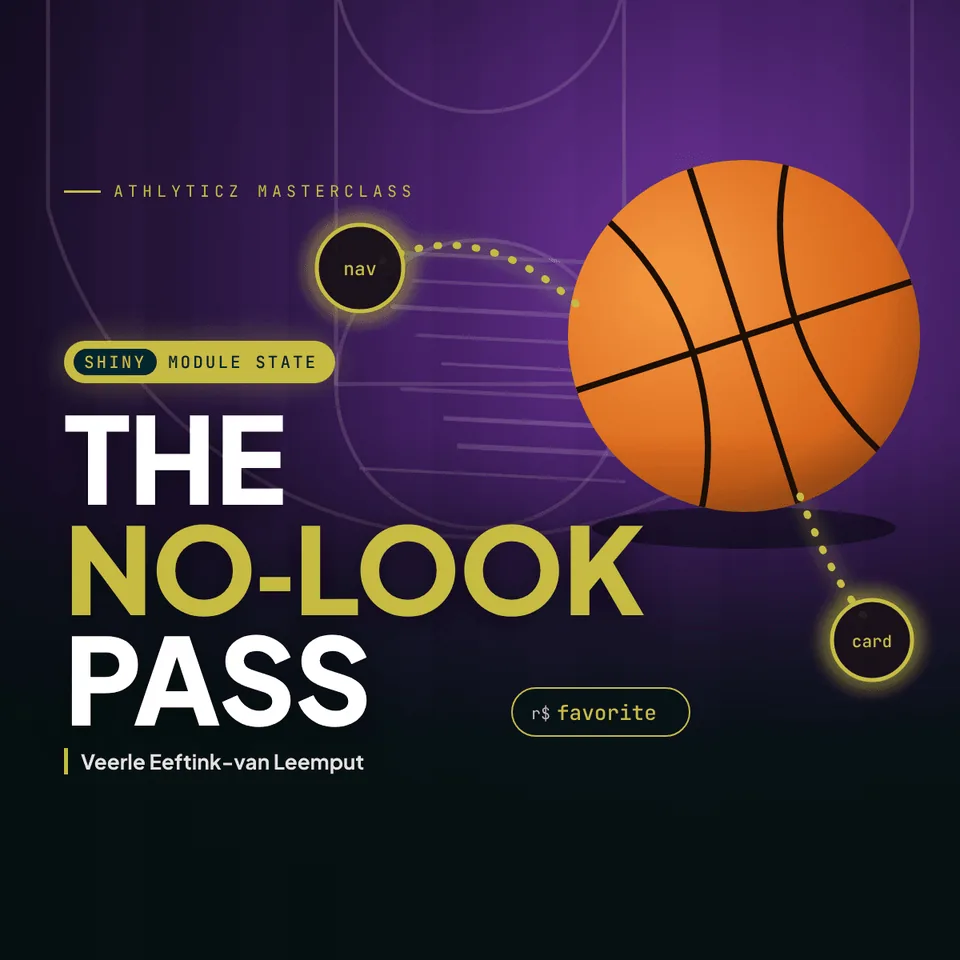
 Async masterclass · 75 min
The No-Look Pass
Veerle Eeftink-van LeemputDirector @ Hypebright B.V.
After this you can share reactive state between Shiny modules with the patterns that scale, and avoid the ones that quietly break.
Programs
Shiny engineering for sport.
R users who want to ship production-grade applications rather than one more dashboard prototype that never leaves a laptop.
Enrolling16 weeks · Foundations to Applied engineering to Capstone
No job is guaranteed. We do not promise placement, an interview, or an offer.
Is this you
Three things people say before they start.
If none of these are familiar, this is probably not the right program, and the call will tell you that faster than the page will.
- You have built an app that works, and you would not want anyone else to read it.
- It is fine until somebody loads a whole season.
- You are the only person who can safely change it, and that is starting to be a problem.
This is a real session, not a promotional cut. App Development runs live alongside the program.
The plan
16 weeks, week by week.
Each phase names the skills you work on, what exists at the end of it, and what you can do by then.
Languages and tools across the program
RJavaScriptDocker
Weeks 1 to 4
Foundations
Fluency in the language the rest of the path is written in, and a project structure that survives a second contributor.
In these weeks
- R and the tidyverse on real sports data
- Project structure, dependency locking, reproducible reports
- End-to-end git workflow: branches, review, and QA gates before anything lands
- Your first application, deliberately small
A reproducible reportA running application
By now you can
Stand up a small application from scratch and hand the repository to someone else without a phone call.
Weeks 5 to 10
Applied engineering
The difference between making dashboards and shipping software, which is mostly architecture and testing.
In these weeks
- Modular architecture, so two people can work on it at once
- Testing, and the QA gates a change has to clear
- Custom components where an off-the-shelf widget will not do
- Deploy and monitor: containers, caching, scaling
- Simulated technical interviews, recorded and reviewed
A modular, tested applicationA deployment pipeline
By now you can
Take an application to production and explain every architectural decision in it to a reviewer.
Weeks 11 to 16
Capstone
One application with a real user in mind, then the rooms it has to survive.
In these weeks
- Deployed capstone application, running somewhere public
- Performance, security, and handover documentation
- Front-office presentation practice: the recommendation, and the pushback
- AI orchestration training: planning work for delegation, delegated builds, browser QA
- Simulated technical interviews, recorded and reviewed
The deployed capstoneA handover documentA portfolio writeup
By now you can
Demonstrate a live application to a room, take a feature request in real time, and say honestly what it would cost.
Not sure which phase you would start from? That is the first thing the call works out.
Ask about this program
Inside the program
The 7 sessions and courses it is built from.
Each one is on sale on its own, as a recording you buy once, on its own page. The program is the order, the weekly work around them and the capstone at the end.
Sessions 4
Async masterclass · 75 min
The No-Look Pass
Veerle Eeftink-van LeemputDirector @ Hypebright B.V.
After this you can share reactive state between Shiny modules with the patterns that scale, and avoid the ones that quietly break.
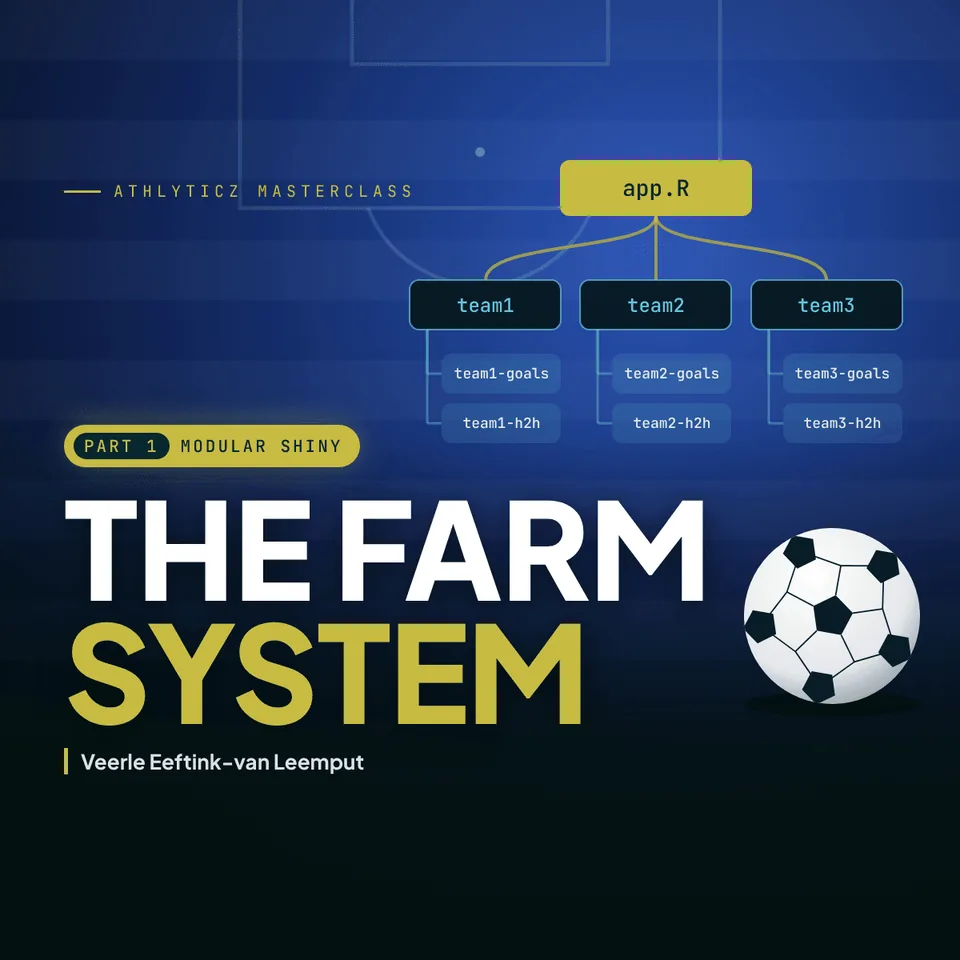 Async masterclass · 75 min
The Farm System
Veerle Eeftink-van LeemputDirector @ Hypebright B.V.
After this you can structure a Shiny app into independent modules you can change one at a time without breaking the rest.
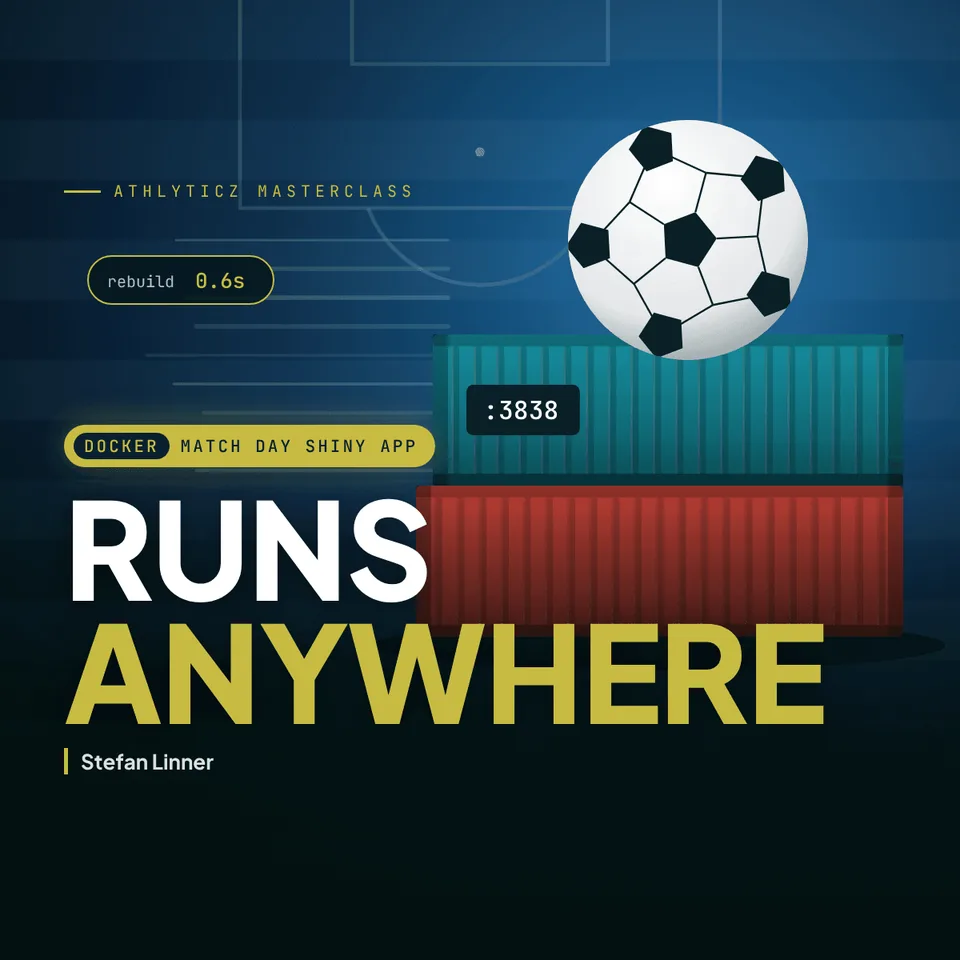 Async masterclass
RUNS ANYWHERE
Dockerizing a Match-Day Shiny App So It Runs Anywhere
Stefan LinnerFounder & R Developer @ LinneRProgramming
After this you can package a Shiny app as a Docker image, run it with Compose, and ship the same image from your laptop to a server.
Courses 3
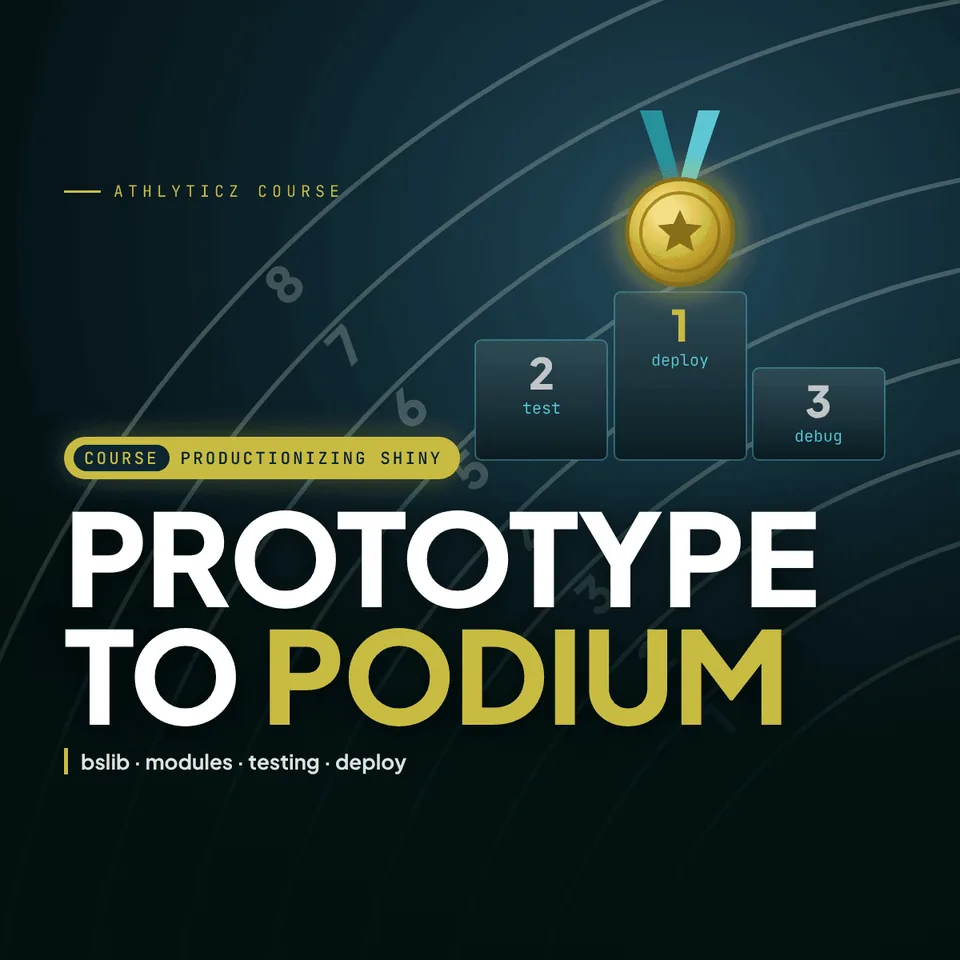 Course · 81 lessons
PROTOTYPE TO PODIUM
ProductioniZing Shiny Applications
Veerle Eeftink-van LeemputDirector @ Hypebright B.V.
After this you can take a Shiny app from prototype to a deployed, tested, maintainable tool.
 Course · 41 lessons
MAKE SHINY YOURS.
CustomiZing WidgetZ
Veerle Eeftink-van LeemputDirector @ Hypebright B.V.
After this you can build your own Shiny inputs, outputs and widgets with R talking to JavaScript.
 Course · 43 lessons
R TO THE APP STORE
Mobile StructureZ
Veerle Eeftink-van LeemputDirector @ Hypebright B.V.
After this you can ship an installable mobile Shiny app that works offline.
The Coaching Room
Practice with somebody on the other side of the table.
AI coaching is built into the practice sessions. The coach takes the stakeholder's part, and you work the problem in whatever medium the question actually calls for.
AI as copilot, not autopilot. You learn to direct the machine and defend the output. The scarce part is not producing an answer; it is knowing whether the answer is right and being able to say why in a room that will push back.
Simulated practice
A clock, a real task, and a room that pushes back.
How it actually runs, and the kind of question it runs on.
Practice is timed. You get a real task and a clock, not a quiz. The session is recorded, and the review afterwards is about the reasoning you showed rather than whether you reached the expected answer.
Scenarios are written the way the question actually arrives- The staff needs the lineup tool on phones before Friday's series, walk me through what ships and what waits.
- An analyst says the app is slow when they load a full season. Where do you look first, and what do you measure?
- Someone new joins the team on Monday. What do you hand them so they can make a change by Wednesday?
Questions
The ones people ask first.
Will I get a job at the end?
No job is guaranteed. We do not promise placement, an interview, or an offer. What the program promises is the work: a capstone you can defend, a portfolio with real builds in it, and interview practice that is recorded and reviewed.
What does it cost?
There is no public price and no checkout on this page. Cost, dates and where you would start are settled on a short call, and the honest answer is sometimes that a single session or course is the better start.
Which weeks would I start from?
That is the first thing the call works out. The plan on this page is the whole route; a person who already has the foundations starts further along it.
Not into sports?
Then take the method and leave the sport. Building a tool that people open, and that survives a second contributor, is the method. The same architecture and the same tests carry into these fields:
- Healthcare Clinical dashboards, where a slow or wrong tool has consequences
- Fintech Internal tools for people who move money and need to see why
- SaaS Analytics products shipped to customers rather than to a colleague
- Research Interactive tools that make a published method usable by others
What runs alongside the taught weeks?
Simulated technical interviews, recorded and reviewed. Front-office presentation practice, where a recommendation meets a room that pushes back. AI orchestration: planning work for delegation, delegated builds, and the checks that catch what a model got wrong.
App Development is the live track running alongside the program, so the weekly sessions and the plan pull in the same direction.
Next step
Ask.
There is no public price and no checkout on this page. A short call settles cost, dates and where you would start, and if a single session is the better start we will say so.
No job is guaranteed. We do not promise placement, an interview, or an offer.
Ask about this program
Keep up
One email when something new arrives.
First name and email. One message when a session recording, a skill, a cheat sheet or a posting worth your time arrives here, and no other mail. Replies reach a person.