Programs · for families

A school year that ends with something to show.

The High School Masterclass: a live session every week in real data science, taught by working practitioners, for high school students.

The Coaching Room

Practice with somebody on the other side of the table.

AI coaching is built into the practice sessions. The coach takes the stakeholder's part, and your student works the problem in whatever medium the question actually calls for.

AI as copilot, not autopilot. Students are taught to direct the machine and defend the output, which is the habit that outlasts whatever tool they end up using.

The year

Three terms, and what exists at the end of each.

Shaped like a school year because that is the rhythm you are already planning against. Every phase names the thing that appears on the screen, not the topic it came from.

Chris Fonnesbeck teaching a masterclassA Bayesian modeling room, mid-build.
Preseason · Weeks 1 to 6

First code, first answers

A student who has never written a line of code opens a notebook in the browser and gets a real answer out of real data in the first session.

In these weeks
  • Python from the beginning
  • Reading a real sports dataset and cleaning it
  • Asking a question of the data and answering it
  • Charts that make a point rather than decorate a slide
  • Weekly live session, recorded, so a game or a meet costs nothing
What exists at the end
A first Python notebookA cleaned datasetA first chart
By the end of preseason

Open a dataset nobody has prepared for them and find something in it worth telling you about.

On an application or a resume

Writes and runs Python. Works with real data rather than classroom exercises. This is the line that separates a student who has taken a coding class from one who has used code to answer a question.

Regular season · Weeks 7 to 18

A real project

The stretch where it stops being exercises. One sports data project, carried from a question through to a finding, at their own pace.

In these weeks
  • Statistics that hold up: averages, rates, and what they hide
  • Working with a season of data rather than a teaching sample
  • Version control, so work is never lost and progress is visible
  • Writing up a finding for someone who does not code
  • Monthly group build alongside the weekly session
What exists at the end
A finished sports data projectA written finding
By the end of the regular season

Explain a result to a room, including what it does not prove.

On an application or a resume

An independent research project with a written conclusion. Something concrete to name in an essay, an interview, or a supplemental question, with a link attached rather than a claim.

Playoffs · Weeks 19 to 30

Something to show

The part that outlasts the school year: a page they can send to anyone, with real work on it and their name at the top.

In these weeks
  • Building and deploying a shareable portfolio page
  • Presenting the work out loud and taking questions
  • A second project chosen by the student, not assigned
  • Communicating technical work to a non-technical audience
What exists at the end
A deployed portfolio pageA presented project
By the end of the season

Send a link to a teacher, a coach, or an admissions reader and have it stand on its own.

On an application or a resume

A live portfolio URL with two projects on it. The rare thing a high school student can put on an application that a reader can actually open and check.

The payoff

What comes out of each term.

The same three terms, with the work that exists at the end of each one. These are the artifacts, drawn from models the student writes.

A student picks the sport. The methods underneath are the same, and the sport is what makes a sixteen-year-old finish the project.

Preseason Weeks 1 to 6
Track

Why the second 200 hurts

A sprint model integrated in the browser: force, a falling top speed, and drag, with 100 meter splits read off the curve.

time (s) velocity (m/s) 100 m11.22s200 m21.70s300 m33.25s400 m46.36s first 200 in 21.70s, second 200 in 24.65s
  • 46.36smodeled 400 m
  • +2.95sthe second-200 fade

An illustrative runner, not a real performance. The split pattern is the one a well-run 400 produces.

Baseball

Pitch tracking, and why the break chart is the tell

Located pitches with break tails, plus horizontal against induced vertical break by pitch type.

Rulebook zone 17″ plate Break, inches glove side arm side
  • Four-seam95.2 mph · +17″ vert · +8″ horz
  • Slider86.4 mph · +1″ vert · -6″ horz
  • Changeup87.9 mph · +6″ vert · +13″ horz
  • Curveball79.6 mph · -10″ vert · -11″ horz

Velocities and break values are illustrative, in the ranges these pitch types actually live in. No real pitcher, team or game.

On an application or a resume

Writes and runs Python. Works with real data rather than classroom exercises. This is the line that separates a student who has taken a coding class from one who has used code to answer a question.

Regular season Weeks 7 to 18
Basketball

The shot chart that killed the mid-range

Expected points per shot over a half court, with a five-touch possession drawn on top.

  • 0.7expected points per shot
  • 0.95the mid-range trough
  • 1.3rim and corners
  • Possessionfive touches, one shot

Shot volumes and percentages are illustrative. The shape is the real argument: a corner three beats a long two on value, not on vibes.

Soccer

Expected goals, and who actually touched the ball

Open-play xG as a logistic in goal angle and log distance, under a passing network sized by touches.

GKRBCBCBLBDMRMCMLWSTAM Open-play xG surface 7.32 m goal
  • xG surfaceangle and distance to goal
  • Node sizetouches in the match
  • Edge weightpasses completed between pair

Positions, touch counts and pass volumes are illustrative. Pitch and penalty-area dimensions are the real ones.

On an application or a resume

An independent research project with a written conclusion. Something concrete to name in an essay, an interview, or a supplemental question, with a link attached rather than a claim.

Playoffs Weeks 19 to 30
Football

A route tree, and the number that moves on every play

Routes drawn at real depths off the line, beside a win probability line across one drive.

+5+10+15+20+25 line of scrimmage FlatSlantOutDigCornerGo Win prob. 50% one drive, eight plays
  • Route depthsflat 2.5, out 12, dig 15, corner 18 yards
  • Biggest swing+0.30 on the turnover

The drive and its probabilities are invented. Route depths are the ones these routes are actually run at.

Tennis and golf

Where the serve actually goes

Two-sigma dispersion ellipses from a bivariate normal, the same object as a golfer's shot cone.

net service line, 21 ft Wide 31%Body 22%T 47%
  • Two-sigma ellipsebivariate normal spread of where serves land
  • Same objecta golfer's shot cone, rotated

Landing-point means, spreads and shares are illustrative. Court and service-box dimensions are the real ones.

On an application or a resume

A live portfolio URL with two projects on it. The rare thing a high school student can put on an application that a reader can actually open and check.

Simulated technical questions

The question arrives the way it actually arrives.

Someone walks up and wants an answer. Practice runs on a clock, and the review afterwards is about the thinking rather than the answer.

Practice is timed. You get a real task and a clock, not a quiz. The session is recorded, and the review afterwards is about the reasoning you showed rather than whether you reached the expected answer.

Scenarios are written the way the question actually arrives
  • Your coach asks: are we actually better this season, or did we just play easier teams? You have twenty minutes and the schedule data.
  • A teammate says the new drill is working. What would you look at to find out whether that is true?
  • Explain your chart to someone who has never seen this data before, in under a minute, without using the word average.
Inside the program

The 2 sessions and courses it is built from.

Each one is on sale on its own, as a recording you buy once, on its own page. The program is the order, the weekly work around them and the capstone at the end.

Sessions 1

Async masterclass · 75 min What Fills the Seats Greg MatthewsPhD · Director, Center for Data Science and Consulting @ Loyola University Chicago Available now After this you can fit ridge, lasso and elastic net on the same data, tune them honestly, and pick the one that generalizes.

Courses 1

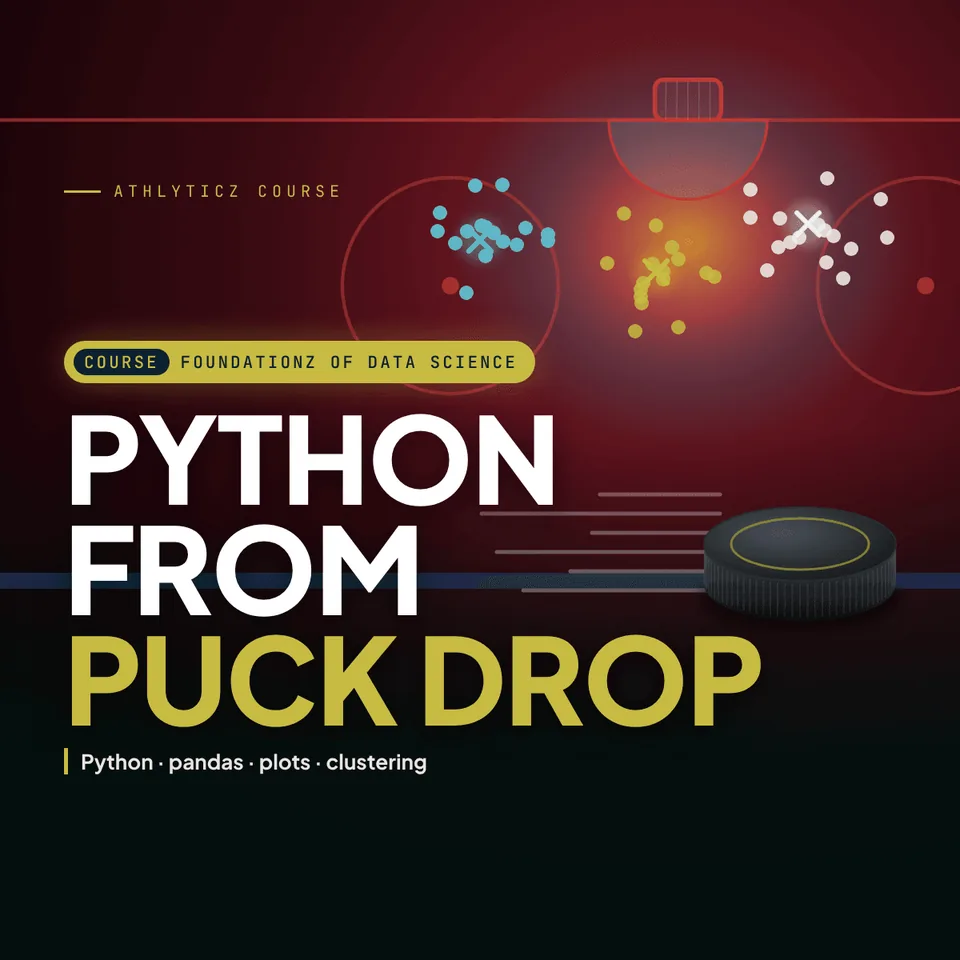
Course · 66 lessons PYTHON FROM PUCK DROP FoundationZ of Data Science Evan Callaghan Available now After this you can load a season of data in Python, clean it, and answer a question nobody handed you the answer to.
Communication training

Explaining it is half the skill, so we teach it.

Technical writing is taught as its own skill: writing up a finding so a reader can follow the reasoning, state what the work shows, and state what it does not. Presenting to a non-technical audience is practiced out loud, with questions afterwards, because a result nobody understood is a result nobody used.

Students work in Python and R, the two languages this field runs on, use version control from early on, and every session is taught live and recorded, so a student who misses one for a game or a meet has not missed the material. The skills are the same foundations the programs are built on, taught at a high school level.

The funding

What we can tell you, and what we cannot.

Education savings account programs differ by state and their rules change without notice to vendors. Here is exactly where we stand.

Arizona. We are an approved ClassWallet vendor, which is the platform Arizona's Empowerment Scholarship Account program pays through. We provide an itemized invoice separating live instruction from curriculum, which is the documentation these programs ask for.

Florida is pending. It runs through a different administrator and a different marketplace. We are working through it and it is not live yet. That is the whole of what we can say today.

Whether your account covers it is your program administrator's decision, not ours. Ask them, and we will provide whatever documentation they need.

We describe what your student builds. We do not promise admission, a scholarship, or a job. We provide completion records. We are not a degree-granting or accrediting institution, and we make no claim about admissions, scholarships, or placement.

A short call: what they are interested in, where they are, and whether this is a fit.

Ask about your student
Keep up

One email when something new arrives.

First name and email. One message when a session recording, a skill, a cheat sheet or a posting worth your time arrives here, and no other mail. Replies reach a person.