Workshop · 100 min · Available now · Modeling & Inference
Build a 3D Athlete from a Single Photo
Go from one phone clip to a 3D skeleton, an avatar and joint angles with their uncertainty bands, and learn the checks that say when not to trust them.
An agent can write the model. This workshop is about knowing when it is wrong.
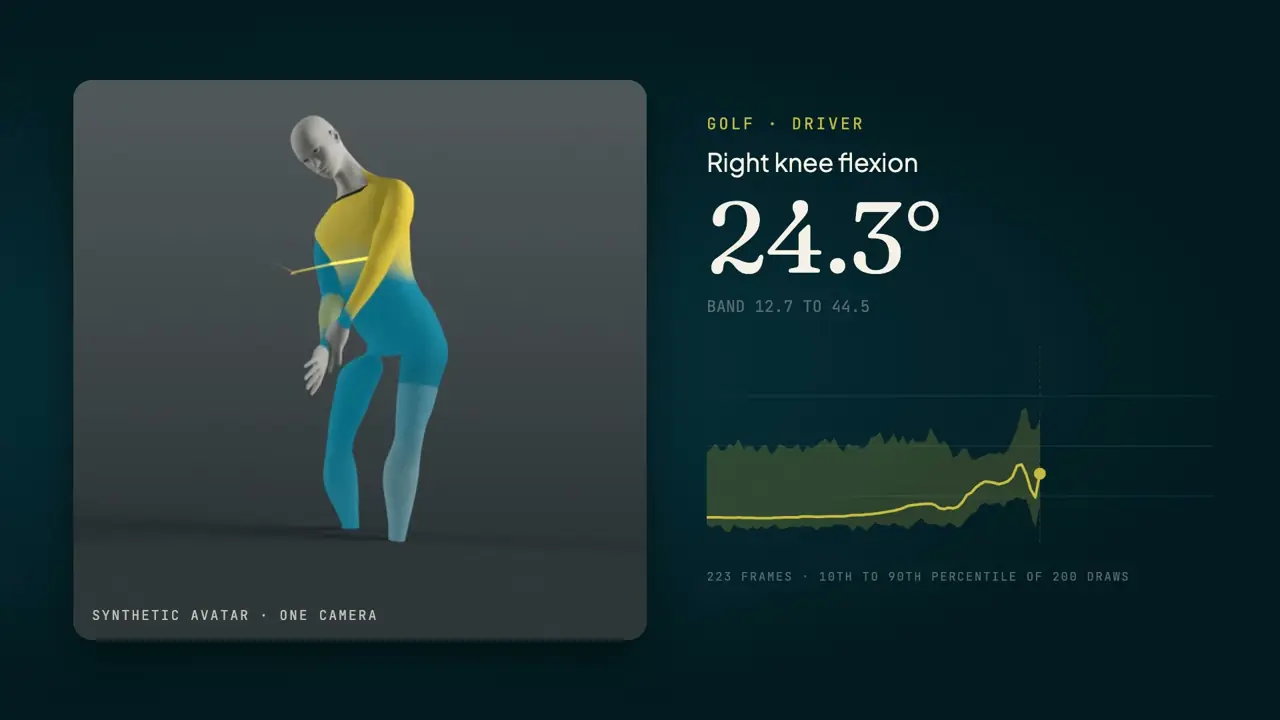
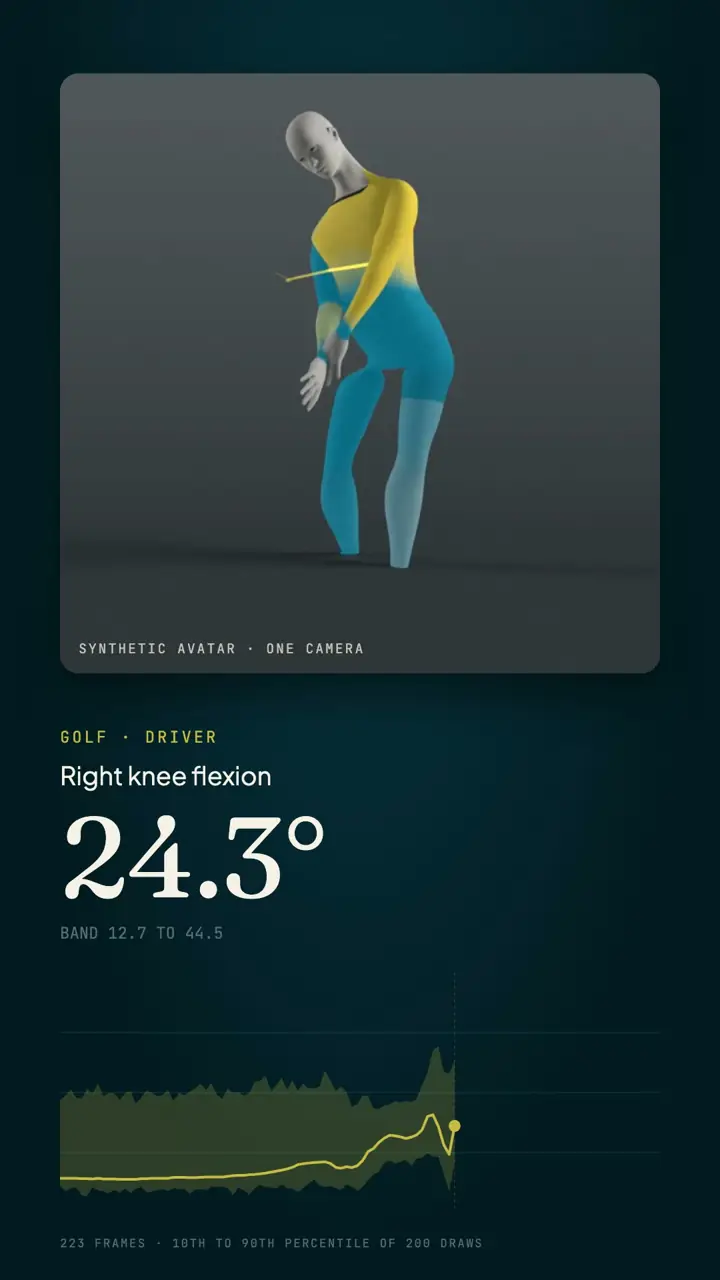
The skills, and the artifact you leave with.
- Describe a body three ways: 17 flat 2D keypoints, the SMPL 3D mesh, and the SKEL skeleton with 46 degrees of freedom and joint limits
- Write down what done means and where the AI must stop before anything runs, then work the loop of spec, generate, run, measure and critique
- Read a joint angle with its uncertainty band, and name the ways a passing check can hide a wrong result
- Build the avatar with free tools, Blender LTS and the MPFB add-on, and color each body segment by its angular speed
- Open the live viewer in a browser, and let a chat app question the result through an MCP server that lists the only tools it may call
The student kit: the pipeline code, the verifier and its test suite, a starter notebook, the setup files and an MCP server template.
A model will hand you a confident 3D body from any clip. The work that matters is the check: which numbers you can defend, and which green results are wrong.
- 01Would You Trust It?7:55
- 02Vibe Versus Engineered10:54
- 03What Is a Body?7:09
- 04The Model4:49
- 05Real Clips Break It7:55
- 06A Number You Can Defend5:30
- 07Close: The Seven Rules and the Lab Kit2:25
- 08Would You Ship It?4:11
- 09Get the AI to Build It9:09
- 10The Skeleton Gets a Body6:12
- 11Green Is Not Right10:39
- 12Motion You Can See4:46
- 13In Your Hand7:08
- 14Ask It a Question4:30
- 15Close: The Fourteen Rules and What's Next7:08
15 lessons, 1 h 40 min.
- 01Would You Trust It?Asks whether one phone video of a golfer hitting a driver can give numbers a coach could use.7:55
- 02Vibe Versus EngineeredContrasts vibe coding, which is asking and accepting, with writing down what done means and where the AI must stop before anything runs.10:54
- 03What Is a Body?Introduces three levels of describing a body from video: 17 flat 2D keypoints, the SMPL 3D mesh, and the SKEL skeleton with 46 degrees of freedom and joint limits.7:09
- 04The ModelExplains how SKEL-CF makes a first guess with a large vision model and refines it six times.4:49
- 05Real Clips Break ItRuns real clips through the pipeline and shows how to check them.7:55
- 06A Number You Can DefendShows how to read uncertainty honestly on the golf clip.5:30
- 07Close: The Seven Rules and the Lab KitCloses part one with the seven rules, none of which is about a model: the person makes the visual call, a green over nothing is the most dangerous green, make the check as big as the promise, read it by name, your frame is not their frame, missing is never invented, and no number without its band.2:25
- 08Would You Ship It?Opens part two with a failure test: frame 158 from an earlier build, where every angle row was green and the avatar-versus-skeleton knee check read exactly zero degrees, yet the legs bowed inward and merged into one column.4:11
- 09Get the AI to Build ItShows the five-step loop of spec, generate, run, measure and critique.9:09
- 10The Skeleton Gets a BodyBuilds the avatar with free tools: Blender LTS, the MPFB add-on and public domain body parts.6:12
- 11Green Is Not RightNames seven ways a passing check can hide a wrong result, using frame 158, where the angle checks missed crossed legs and the knee check compared the skeleton with itself and read 0.0.10:39
- 12Motion You Can SeeColors each body segment by its angular speed in degrees per second, computed from the segment direction before and after each frame, scaled by frame rate, eased, and mapped to one fixed top value per clip.4:46
- 13In Your HandTours the live viewer running in a browser, the same page a coach opens on a phone, and explains that the back of the avatar is the model's best estimate.7:08
- 14Ask It a QuestionIntroduces MCP, the Model Context Protocol, as a small contract in which a chat app starts your server over a plain text line and the model can only call the tools the server lists.4:30
- 15Close: The Fourteen Rules and What's NextCloses on the verifier rather than the avatar, explaining the 24 red rows and sorting them into four kinds: finding, known limit, to fix, and open.7:08
Three clips, straight from the workshop.
Failures Should Go Up 0:30
The Student Inherits Teacher's Mistakes 0:34
Which Part Do People Skip? 0:35
97 files, ready to run.
One zip, 2.3 MB (2.9 MB unpacked). Its own test suite was run inside the kit before it shipped: 99 passed, 9 skipped (tests that need the body model or a GPU, which the kit does not ship).
| Path | Files | Size |
|---|---|---|
pipeline | 37 | 311 KB |
assignment.md | 1 | 2 KB |
pytest.ini | 1 | 0 KB |
LICENSE | 1 | 2 KB |
verify | 9 | 56 KB |
tests | 29 | 2433 KB |
NOTICE | 1 | 2 KB |
README.md | 1 | 12 KB |
.gitignore | 1 | 0 KB |
clips.json | 1 | 0 KB |
scripts | 1 | 3 KB |
templates | 3 | 9 KB |
starter.ipynb | 1 | 9 KB |
envs | 3 | 15 KB |
doctor.py | 1 | 10 KB |
mcp_template | 6 | 22 KB |
Not in the zip, by design: no clips, no body model files, no checkpoints, no third-party code. The kit's doctor.py says what to download and where.
Every angle check can pass while the result is plainly wrong. A green over nothing is the most dangerous green.
Three decisions it teaches- Which description of a body the question needs: flat keypoints, a mesh, or a skeleton with joint limits
- What done means, written down before the AI builds anything, and where it must stop
- When a number is safe to show a coach: never without its band, and never from a check that compares a thing with itself
The artifact. The student kit: the pipeline code, the verifier and its test suite, a starter notebook, the setup files and an MCP server template.
- Build a 3D Athlete from a Single Photo
One live session, recorded, 100 minutes. Yours to keep and watch any time.
Everything that exists for this session, and nothing that does not.
- The recording100 minutes, yours to keep
PhD · Principal Data Scientist, AI @ Broadata Communications
Teaches the method the way it is used in the role above. The team page lists everything they teach here.
Michael Czahor, Principal Data Scientist, AI at Broadata Communications, holds a PhD. Before that, Michael was Lead Quantitative Analyst with the Phillies, Principal Quantitative Analyst with the Tigers and Special Assistant, R&D with the Marlins. On AthlyticZ, Michael teaches Build a 3D Athlete from a Single Photo.
What is yours when you buy.
- The full recording, 100 min
- Yours to keep: watch it any time
- The student kit: 97 files in one zip, with its own test suite
Refunds. If you bought it and it is the wrong one for you, write to michael@athlyticz.com and a person will answer.
The ones that stop a purchase.
Is this too advanced, or too basic, for me?
Built for someone who already writes code in the session's language and wants the method, not the syntax. If the outcome line at the top reads like something you could use next week, it is pitched right. If it reads like a different job, start with the courses on /browse.
What exactly do I get, and for how long?
The full recording, yours to keep: buy once, watch any time. Masterclass subscribers get every live session for a year and keep every session that is recorded. Everyone else can buy a recording on its own.
Do I need to install anything?
No. The recording plays in the browser.
What if it is not for me?
Twenty minutes on a call before you buy costs nothing, and the call is the fastest way to tell. If you bought it and it is the wrong one for you, email michael@athlyticz.com and a person will answer.
We run 120 live sessions a year. At $79 each that is $9,480.
The Masterclass is every one of them, live and recorded, for $1,899 a year, or $199 a month, or 3 monthly payments of $699. Paid by the month, it renews monthly at $199, cancel any time by replying to your receipt.
Every live session this year, and every recording.
Join the Masterclass